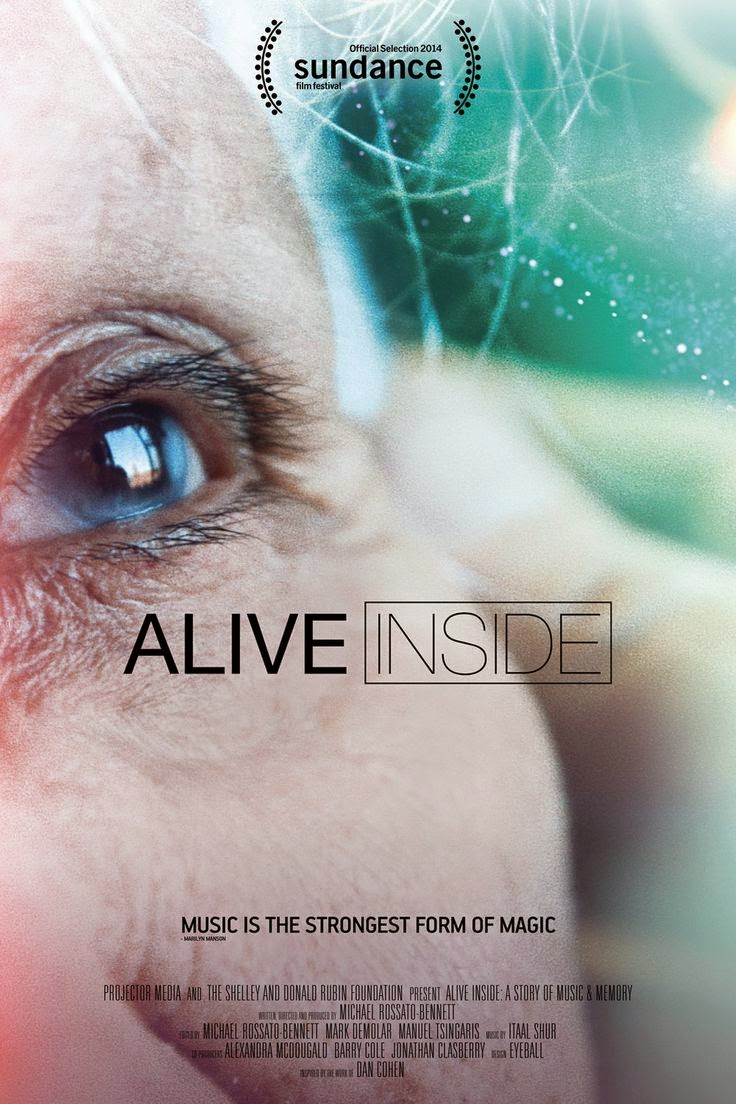
Alive Inside is an important subject with a clunky execution


This is a documentary film about the use music therapy with elderly nursing home patients. Apparently when the patients who are other wise borderline catatonic hear music from their youth they open up, talk, dance and sing. The film follows one man who wants to implement music therapy programs in all 1600 nursing homes in the United States. Clearly he has a lofty goal but one that could be achieved.

Its difficult to separate a documentary films subjects from its makers but I feel like you must do it with Alive Inside. The subject matter is heart warming, saddening, frustrating and strikingly urgent but the heavy handed approach of the filmmakers is distracting and shows a lack of faith in his subject. With that being said the subject is powerful enough to transcend its execution. When you are discussing dementia  and  alzheimer's have faith the viewer can understand you're point without having trippy slow-motion shots of grandma looking confused and scared. These moments are minimal but they do a disservice to the overall quality of the film and undercut its important message.

The idea of music therapy is a controversial one but clearly its an area that could use further research and funding. The most interesting part of the film is when it goes into the history of nursing homes. When we introduced the New Deal, Social Security and Medicade the  nursing homes moved from spaces that were designed to emulate homes to spaces that were designed to emulate hospitals.

Pardon me while I get on my soapbox

We don't age well in this country I'm an American so I assume that everyone who reads this is American, we are a myopic bunch of pricks. The elderly are rarely treated with the respect and dignity that they deserve. If some Big Band jams can bring the near catatonic out of their internal prisons, fund it, fund it now. I want someone to bring me a Black Flag tape when I'm 89 and I want that 20 year old orderly handing me my iPod to think my music is old fashion and silly. I hope that moment exists.

I'm a selfish American and I believe in taking care of our older citizen's. Not because I'm altruistic but because I want the systems to be in place for me when I get old. I don't believe that doing the right thing is necessarily a selfless act. Just try to remember that you will one day be old too. How do want to be treated? If you have a relative in a nursing home, even if you like them, make sure they are being treated well. Looking out for elderly is the least we can do to say thank you.


Comments

Popular posts from this blog

Explaining the Ending of MULHOLLAND DRIVE

David Lynch’s Mulholland Drive remains one of the most haunting and enigmatic films ever made. It operates like a riddle that refuses to be solved, luring the viewer into a world where time, memory, and identity dissolve into one another. What begins as a mysterious, almost whimsical Hollywood fairy tale gradually transforms into a psychological nightmare. By the end, it’s clear that what we’ve been watching is not a mystery to be unraveled but an emotional landscape, the mind of a woman caught between fantasy and despair. The film tells the story of two women, Betty Elms and Rita, whose lives intertwine after Rita survives a car crash and loses her memory. Betty, a bright and optimistic aspiring actress freshly arrived in Los Angeles, takes her in. Together, they embark on an investigation into Rita’s identity, which unfolds like a noir detective story bathed in dreamlike light. Everything about this world feels heightened: Betty’s charm, the coincidence of events, and the ease with w...

Explaining the Ending of No Country for Old Men

No Country for Old Men is a tense, spare, and philosophical thriller that upends traditional narrative expectations. While it contains the elements of a crime drama—drug deals, hitmen, shootouts—it refuses to follow a conventional path. By the time the film ends, the central conflict seems unresolved, the villain walks away, and the protagonist we’ve been following disappears offscreen. To understand the film’s ending, one must look beyond plot and consider its themes: fate, violence, moral decay, and the erosion of order in the modern world. The Narrative Setup The story begins with Llewelyn Moss (Josh Brolin), a Vietnam veteran who discovers a drug deal gone wrong in the Texas desert and makes off with $2 million in cash. Anton Chigurh (Javier Bardem), a remorseless hitman, is sent to retrieve the money. Sheriff Ed Tom Bell (Tommy Lee Jones), a weary and introspective lawman, tries to make sense of the violence unfolding around him. At first glance, the film appears to set up a c...

Dracula (2026) Trailer, Release Date, Cast, and Plot Details

Dracula (2026) Trailer, Release Date, Cast, and Plot Details Vertical has officially announced that DRACULA (2026), the latest reimagining of the iconic vampire myth, will be released exclusively in theaters nationwide on February 6, 2026. Written, directed, and produced by visionary filmmaker Luc Besson, the film promises a dark, operatic take on one of cinema’s most enduring legends. Dracula (2026) Cast and Creative Team Besson’s Dracula (2026) stars Caleb Landry Jones in the title role, joined by an impressive ensemble that includes Christoph Waltz, Zoë Bleu, Guillaume de Tonquedec, Matilda De Angelis, Ewens Abid, and Raphael Luce. The film is executive produced by Mark Canton, Dorothy Canton, Ryan Winterstern, and Philippe Corrot, further cementing the project as a major cinematic event. Dracula (2026) Plot Synopsis Set against the brutal backdrop of the 15th century, Dracula (2026) begins with profound personal tragedy. After witnessing the savage murder of his beloved wife (Zoë B...