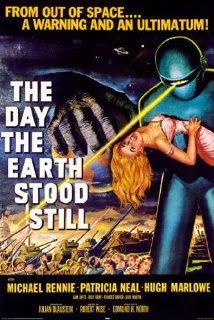
The Day the Earth Stood Still


1951
Directed By Robert Wise
Starring Michael Rennie, Patricia Neal and Hugh Marlowe

Based on the short story Farewell to the Master, The Day the Earth Stood still is a 1951 anti-war film directed by Robert Wise. The film opens with a flying saucer landing at a baseball park in Washington DC. After landing a humanoid exits the craft and announces he has come in peace. The humanoid begins to approach a crowd that has formed and opens a small tube but before he can finish opening the tube he is quickly gunned down by an antsy soldier. Gort, a large robotic like being comes out of the saucer and begins to shoot ray beams from his face mask at all the soldiers weapons. In a matter of moments having neutralized all the weapons Gort is ordered to stop shooting by the humanoid.

They came in peace, bearing gifts and we shot them. The film clearly has an agenda and unlike Invasion of the Body Snatchers there is nothing subtle about its approach. The message is clearly laid out by our visitor and in turn the film wears its heart on its pacifist leaning sleeve. With lines like: “no war? That’s a good idea”, you would be hard pressed to miss the point of this film. While the film isn’t subtle it’s also not preachy.  I never found myself thinking “alright I get it” and that is a difficult balance to strike.

I've been going back and watching science fiction and horror films from the 50s and 60s lately and one thing has become abundantly clear, a great number of film makers who worked in genre pictures made intelligent films for adults that had scares and action but they also had heart and mind, something that is sadly missing from most modern horror and scifi.  The Day the Earth Stood Still earns its status as a classic rightfully. The film has a message but it goes down smooth and that message is timeless, something worth repeating.

Sadly, the remake of this film seemed to completely miss the point. Don’t bother watching it, please just go back and watch the original. I can see the remake was made with a competent cast and crew but they just didn’t crack the script, it felt flat and lifeless. Sure it had pretty special effects and plenty of loud noises but it was boring. The remake is great example of sound and fury signifying nothing. Thank you Billy Shakes.  


When I was watching this a friend came in and asked me if I was watching Leave it to Beaver. Yes this is a 60 year old black and white film that has been remade into a forgettable film starring Neo but if you are struggling to find something to watch on Netflix and you're thinking about re watching that last season of Supernatural give this one a shot. You won’t regret it.

Comments

Popular posts from this blog

Explaining the Ending of MULHOLLAND DRIVE

David Lynch’s Mulholland Drive remains one of the most haunting and enigmatic films ever made. It operates like a riddle that refuses to be solved, luring the viewer into a world where time, memory, and identity dissolve into one another. What begins as a mysterious, almost whimsical Hollywood fairy tale gradually transforms into a psychological nightmare. By the end, it’s clear that what we’ve been watching is not a mystery to be unraveled but an emotional landscape, the mind of a woman caught between fantasy and despair. The film tells the story of two women, Betty Elms and Rita, whose lives intertwine after Rita survives a car crash and loses her memory. Betty, a bright and optimistic aspiring actress freshly arrived in Los Angeles, takes her in. Together, they embark on an investigation into Rita’s identity, which unfolds like a noir detective story bathed in dreamlike light. Everything about this world feels heightened: Betty’s charm, the coincidence of events, and the ease with w...

Explaining the Ending of No Country for Old Men

No Country for Old Men is a tense, spare, and philosophical thriller that upends traditional narrative expectations. While it contains the elements of a crime drama—drug deals, hitmen, shootouts—it refuses to follow a conventional path. By the time the film ends, the central conflict seems unresolved, the villain walks away, and the protagonist we’ve been following disappears offscreen. To understand the film’s ending, one must look beyond plot and consider its themes: fate, violence, moral decay, and the erosion of order in the modern world. The Narrative Setup The story begins with Llewelyn Moss (Josh Brolin), a Vietnam veteran who discovers a drug deal gone wrong in the Texas desert and makes off with $2 million in cash. Anton Chigurh (Javier Bardem), a remorseless hitman, is sent to retrieve the money. Sheriff Ed Tom Bell (Tommy Lee Jones), a weary and introspective lawman, tries to make sense of the violence unfolding around him. At first glance, the film appears to set up a c...

Dracula (2026) Trailer, Release Date, Cast, and Plot Details

Dracula (2026) Trailer, Release Date, Cast, and Plot Details Vertical has officially announced that DRACULA (2026), the latest reimagining of the iconic vampire myth, will be released exclusively in theaters nationwide on February 6, 2026. Written, directed, and produced by visionary filmmaker Luc Besson, the film promises a dark, operatic take on one of cinema’s most enduring legends. Dracula (2026) Cast and Creative Team Besson’s Dracula (2026) stars Caleb Landry Jones in the title role, joined by an impressive ensemble that includes Christoph Waltz, Zoë Bleu, Guillaume de Tonquedec, Matilda De Angelis, Ewens Abid, and Raphael Luce. The film is executive produced by Mark Canton, Dorothy Canton, Ryan Winterstern, and Philippe Corrot, further cementing the project as a major cinematic event. Dracula (2026) Plot Synopsis Set against the brutal backdrop of the 15th century, Dracula (2026) begins with profound personal tragedy. After witnessing the savage murder of his beloved wife (Zoë B...