Mammoth Film Festival 2022: THE ABANDON Review

2022

Director: Jason Satterlund

Starring: Jonathan Rosenthal and Tamara Perry

A bottle episode is a device most commonly associated with television that limits locations to only one room or set. Famously, episodes of SEINFELD, BREAKING BAD, and THE SOPRANOS have used a limited scope to create some of their most memorable episodes. Films as diverse as 12 ANGRY MEN, MY DINNER WITH ANDRE, and ROPE have all played in this claustrophobic sandbox. Going on three years of pandemic-induced isolation, it makes sense that filmmakers are gravitating towards limited scope in their narratives. Not only is it a way to help ensure safety on a set it's a logical way to reflect the loneliness and dread we are all experiencing.        

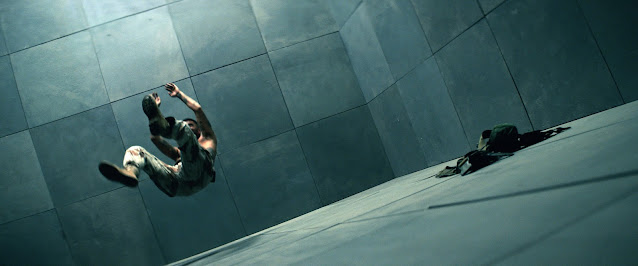
Miles Willis, a wounded Army soldier, is having a bad day. Not only has he been shot but he finds himself trapped in a gray tiled room that defies his basic understanding of physics. Gravity appears to be subjective if not manipulated, the temperature quickly shifts to extremes, and writing appears on the walls from an unseen presence. 

All films are dependent on their casting but a few conceits like a bottle episode will test an actor's ability. In THE ABANDON Jonathan Rosenthal is the sole person we see on screen for the majority of the 90-minute runtime. The film is completely told from his point of view, a man with a bullet in his stomach trying to make sense of the senseless situation he finds himself in. If you put the wrong actor in this role there is no way to cut around or hide it. In many ways this film could work as a black box play, it is that much of a performance-driven piece. A drama/horror/sci-fi/thriller black-box piece but one that is absolutely rooted in performance and Rosenthal is up for the task of selling this character. 

While the film is not pushing the audience to distrust Miles, it's hard not to question how much of what we are witnessing is real, after all, it would be completely understandable if our protagonist was a bit off in his perception of reality. And that's something most of us have experienced over the last three years, a shift in reality pushed by disembodied forces, a desperate need to connect, and the feeling that maybe it is time to abandon hope. The sense that we need to let go to move on is becoming more pervasive and the fear of what lies on the other side is becoming calloused. We can't remain on high alert in perpetuity, eventually, we run out of fucks to give. 

While not directly a film about the pandemic, THE ABANDON is certainly playing with our current psyche and makes what could have been a disposable thriller into something worthy of examination.


Comments

Hyder Ak47 said…
This comment has been removed by the author.

Popular posts from this blog

Explaining the Ending of MULHOLLAND DRIVE

David Lynch’s Mulholland Drive remains one of the most haunting and enigmatic films ever made. It operates like a riddle that refuses to be solved, luring the viewer into a world where time, memory, and identity dissolve into one another. What begins as a mysterious, almost whimsical Hollywood fairy tale gradually transforms into a psychological nightmare. By the end, it’s clear that what we’ve been watching is not a mystery to be unraveled but an emotional landscape, the mind of a woman caught between fantasy and despair. The film tells the story of two women, Betty Elms and Rita, whose lives intertwine after Rita survives a car crash and loses her memory. Betty, a bright and optimistic aspiring actress freshly arrived in Los Angeles, takes her in. Together, they embark on an investigation into Rita’s identity, which unfolds like a noir detective story bathed in dreamlike light. Everything about this world feels heightened: Betty’s charm, the coincidence of events, and the ease with w...

Explaining the Ending of No Country for Old Men

No Country for Old Men is a tense, spare, and philosophical thriller that upends traditional narrative expectations. While it contains the elements of a crime drama—drug deals, hitmen, shootouts—it refuses to follow a conventional path. By the time the film ends, the central conflict seems unresolved, the villain walks away, and the protagonist we’ve been following disappears offscreen. To understand the film’s ending, one must look beyond plot and consider its themes: fate, violence, moral decay, and the erosion of order in the modern world. The Narrative Setup The story begins with Llewelyn Moss (Josh Brolin), a Vietnam veteran who discovers a drug deal gone wrong in the Texas desert and makes off with $2 million in cash. Anton Chigurh (Javier Bardem), a remorseless hitman, is sent to retrieve the money. Sheriff Ed Tom Bell (Tommy Lee Jones), a weary and introspective lawman, tries to make sense of the violence unfolding around him. At first glance, the film appears to set up a c...

Dracula (2026) Trailer, Release Date, Cast, and Plot Details

Dracula (2026) Trailer, Release Date, Cast, and Plot Details Vertical has officially announced that DRACULA (2026), the latest reimagining of the iconic vampire myth, will be released exclusively in theaters nationwide on February 6, 2026. Written, directed, and produced by visionary filmmaker Luc Besson, the film promises a dark, operatic take on one of cinema’s most enduring legends. Dracula (2026) Cast and Creative Team Besson’s Dracula (2026) stars Caleb Landry Jones in the title role, joined by an impressive ensemble that includes Christoph Waltz, Zoë Bleu, Guillaume de Tonquedec, Matilda De Angelis, Ewens Abid, and Raphael Luce. The film is executive produced by Mark Canton, Dorothy Canton, Ryan Winterstern, and Philippe Corrot, further cementing the project as a major cinematic event. Dracula (2026) Plot Synopsis Set against the brutal backdrop of the 15th century, Dracula (2026) begins with profound personal tragedy. After witnessing the savage murder of his beloved wife (Zoë B...